Table of Contents
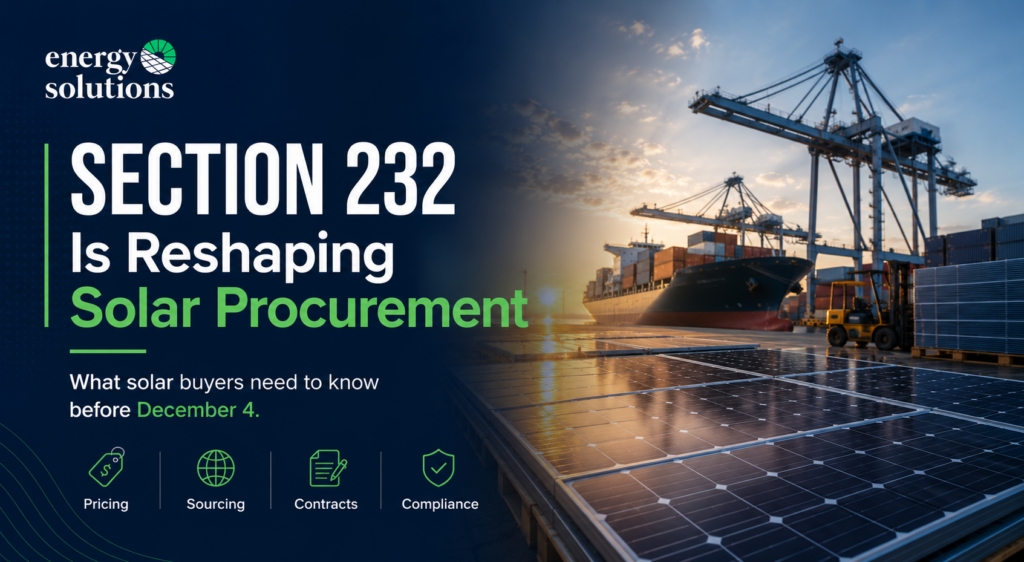
On August 6, 2026, the United States announced a new Section 232 trade framework covering polysilicon and key products across the solar supply chain.
The measures take effect on December 4, 2026 and introduce minimum import prices for polysilicon, ingots and wafers, solar cells and solar modules, along with additional duties on certain covered downstream products.
For solar developers, EPCs, manufacturers, importers and procurement teams, the practical issue is not simply whether tariffs are increasing.
The bigger question is:
How will Section 232 affect the cost, sourcing, timing and risk of the solar equipment your projects need?
What is the new Section 232 solar action?
Section 232 allows the U.S. government to take trade action when imports are determined to threaten national security.
In this case, the new framework is intended to strengthen U.S. production of polysilicon and solar components while reducing dependence on highly concentrated overseas supply chains.
Beginning December 4, covered imports will be subject to new minimum import prices.
Section 232 minimum import prices
| Product | Minimum Import Price |
|---|---|
| Polysilicon | $21/kg |
| Ingots and wafers | $100/kg |
| Solar cells | $0.22/W |
| Solar modules | $0.38/W |
Covered downstream products may also face additional Section 232 duties depending on the product and country of origin.
Raw polysilicon is treated differently. It is subject to the $21/kg minimum import price, but it is not subject to the new additional tariff that applies to covered downstream products.
That distinction is important because the new framework affects different parts of the solar supply chain differently.
How will Section 232 affect solar procurement?
Section 232 could directly change how solar equipment is sourced and evaluated.
Procurement teams will need to look beyond the quoted equipment price and consider:
- product origin;
- expected U.S. entry date;
- tariff classification;
- supplier structure;
- contract terms;
- documentation;
- delivery schedule;
- available alternative products or suppliers.
Two projects purchasing similar modules may not have the same exposure if the products come through different supply chains or enter the United States at different times.
That means a supplier quote today may not necessarily represent the final landed cost of the equipment once the new framework takes effect.
For project teams, supplier selection, timing and contract structure are becoming more important parts of the purchasing decision.
Could Section 232 increase solar module prices?
Yes.
The exact impact will depend on the sourcing structure, but recent industry analysis points to meaningful increases in U.S. solar equipment costs.
One estimate suggests the new framework could increase average module costs by approximately $0.10/W, depending on how modules, cells and wafers are sourced.
For perspective:
A $0.10/W increase on a 100 MW solar project represents approximately $10 million in additional module cost.
The same analysis estimates that the increase could require approximately $4–$5/MWh in additional PPA pricing to offset higher project capital costs.
These figures are estimates rather than guaranteed outcomes. Actual impacts will depend on factors including supplier, manufacturing location, product type, existing trade measures and contract structure.
But they demonstrate why Section 232 can quickly become a project economics issue, not simply a trade-policy issue.
What should solar project teams review before December 4?
Projects with equipment being quoted, purchased or delivered around the implementation date should review their procurement strategy now.
Key questions include:
- Where is the equipment manufactured?
- When is it expected to enter the United States?
- Is pricing fixed under a firm purchase agreement?
- What duties or other costs are included in the supplier’s price?
- What happens if delivery is delayed beyond December 4?
- Are alternative products or suppliers available?
- Can the supply chain and transaction be properly documented?
These questions can affect more than customs compliance.
They can influence project cost, construction schedule, financing assumptions and purchasing decisions.
Why does documentation matter under the new rules?
Documentation becomes significantly more important under the new minimum import price framework.
If required minimum-price documentation is not provided, an importer may face a duty equal to the full applicable minimum import price, rather than simply paying the difference between the transaction value and the price floor.
That creates a strong incentive for buyers and importers to work with suppliers that can provide reliable information about:
- origin;
- transaction pricing;
- production;
- supply-chain traceability;
- supporting records.
For procurement teams, the ability to verify a supplier’s supply chain is becoming part of the commercial decision.
A low equipment price carries less value if the transaction creates significant compliance or documentation risk.
Are solar contracts signed before August 6 exempt?
Not automatically.
A qualifying agreement entered into before August 6 may be relevant under certain parts of the new minimum-price framework, but an existing contract should not be assumed to provide a blanket exemption.
Factors that may matter include:
- when the agreement was signed;
- whether its terms are fixed;
- contract duration;
- pricing;
- quantity;
- amendments;
- delivery schedule;
- the structure of the actual transaction.
A pre-August 6 contract does not necessarily mean future shipments will be unaffected by additional duties or other requirements.
For projects relying on existing supply agreements, the contract should be reviewed before assuming the economics remain unchanged after December 4.
Should companies accelerate solar imports before December 4?
Not necessarily.
Bringing equipment into the United States before the effective date may appear attractive, but shipment timing should be driven by the project’s actual commercial requirements.
Accelerating equipment purchases can create other issues involving:
- working capital;
- warehousing;
- storage risk;
- warranty timing;
- construction schedules;
- project changes;
- inventory exposure.
The new framework also contains provisions intended to discourage stockpiling before implementation.
The better question is not:
“How do we import everything before December 4?”
It is:
“What should we secure now, what can wait, and where do we still have flexibility?”
That is a procurement decision, not simply a tariff decision.
How does Section 232 support U.S. solar manufacturing?
The broader objective of the policy is to encourage more of the solar supply chain to be manufactured in the United States.
That includes:
- polysilicon;
- ingots;
- wafers;
- solar cells;
- finished modules.
The United States has already added significant module assembly capacity, but important gaps remain further upstream, particularly in ingot, wafer and cell manufacturing.
Global polysilicon production also remains highly concentrated, with industry estimates placing China’s share above 90%.
The new trade framework is intended to improve the economics of investing in U.S. manufacturing while reducing dependence on concentrated foreign supply chains.
The government has also authorized an incentive program for qualifying investments in U.S. polysilicon, ingot, wafer and cell production. Eligible projects are expected to commit to beginning construction by January 20, 2029.
Building that capacity will take time.
Until the U.S. supply chain becomes more fully integrated, developers and procurement teams will still need to balance imported equipment, domestic supply, project schedules and changing costs.
What should developers, EPCs and procurement teams do now?
Companies should not wait until November to evaluate their exposure.
For projects that could extend beyond December 4, start by reviewing the actual equipment being considered.
Focus on:
- Supplier and manufacturer
- Product origin
- Current pricing
- Contract terms
- Expected U.S. entry date
- Documentation
- Alternative products or sources
Then ask:
If pricing, timing or availability changes, what options does the project still have?
Strong procurement planning is not about predicting every trade-policy outcome.
It is about preserving enough flexibility to respond when conditions change.
How Energy Solutions and Supplies can help
At Energy Solutions and Supplies (ESAS), we help solar developers, EPCs and procurement teams understand their equipment options before making the next commitment.
We can evaluate:
- available module and equipment supply;
- sourcing alternatives;
- inventory;
- current pricing;
- delivery timing;
- alternative products;
- project requirements.
Our goal is not to tell customers to buy equipment early simply because a new trade rule has been announced.
Our role is to help project teams understand where they may have exposure, where they still have flexibility and what sourcing options are available.
If you have equipment under contract, an upcoming purchase decision or deliveries that may extend beyond December 4, now is the time to review the project.
Talk to ESAS before you make the next move.
The most important question is not simply:
“What did Section 232 change?”
It is:
“What does Section 232 change for my project — and what can I do about it now?”
Frequently Asked Questions About Section 232 and Solar
When do the new Section 232 solar rules take effect?
The new framework takes effect on December 4, 2026, for covered products entering the United States under the applicable rules.
What is the minimum import price for solar modules?
The minimum import price for covered solar modules is $0.38 per watt.
What is the minimum import price for solar cells?
Covered solar cells have a minimum import price of $0.22 per watt.
What is the minimum import price for polysilicon?
The minimum import price for covered polysilicon is $21 per kilogram.
Are solar wafers covered by Section 232?
Yes. Covered polysilicon ingots and wafers have a minimum import price of $100 per kilogram and may also face additional duties.
Does raw polysilicon face the new 15% downstream tariff?
Raw polysilicon is subject to the minimum import price but is not subject to the new additional tariff applied to covered downstream products.
Will Section 232 increase solar project costs?
It may. Recent industry estimates suggest average module costs could increase by approximately $0.10/W, although the actual impact will vary based on sourcing and project structure.
Are contracts signed before August 6 grandfathered?
Not automatically. A qualifying pre-August 6 agreement may be relevant under certain provisions, but it does not create a blanket exemption from all new duties or requirements.
Should solar developers buy modules before December 4?
Not necessarily. Projects should evaluate pricing, delivery timing, storage, contracts, alternatives and actual construction requirements before accelerating purchases.
How can ESAS help with Section 232?
ESAS can help project teams review solar equipment availability, sourcing options, pricing, inventory, delivery timing and alternative products so they can make informed procurement decisions as the new rules take effect.
Talk with an ESAS procurement specialist to discuss:
- Commercial solar procurement strategy
- Commercial BESS solutions
- Supply-chain planning
- Domestic Content documentation
- Inventory reservation
- Project logistics and delivery coordination
Contact ESAS today to learn how we can support your upcoming commercial solar projects.
Disclaimer: This article is for general informational purposes only and does not constitute legal, tax or financial advice. Trade, customs and project-specific compliance questions should be reviewed with qualified professionals.
References & Further Reading
- White House — Adjusting Imports of Polysilicon and its Derivatives into the United States — Official August 6, 2026 proclamation establishing the minimum import prices, tariffs, compliance requirements and U.S. onshoring program.
- White House — Fact Sheet: Polysilicon and Derivatives Section 232 Action — Summary of the administration’s rationale and key provisions.
- U.S. Department of Commerce, Bureau of Industry and Security — Section 232 Polysilicon Investigation — Original notice opening the national-security investigation into polysilicon and derivative imports.
- Bureau of Industry and Security — Section 232 Investigations — Commerce overview and status of Section 232 investigations, including polysilicon.